
What is Mindful Flow?
Mindful Flow classes are held three days a week -Tuesday, Thursday, and Saturday mornings.
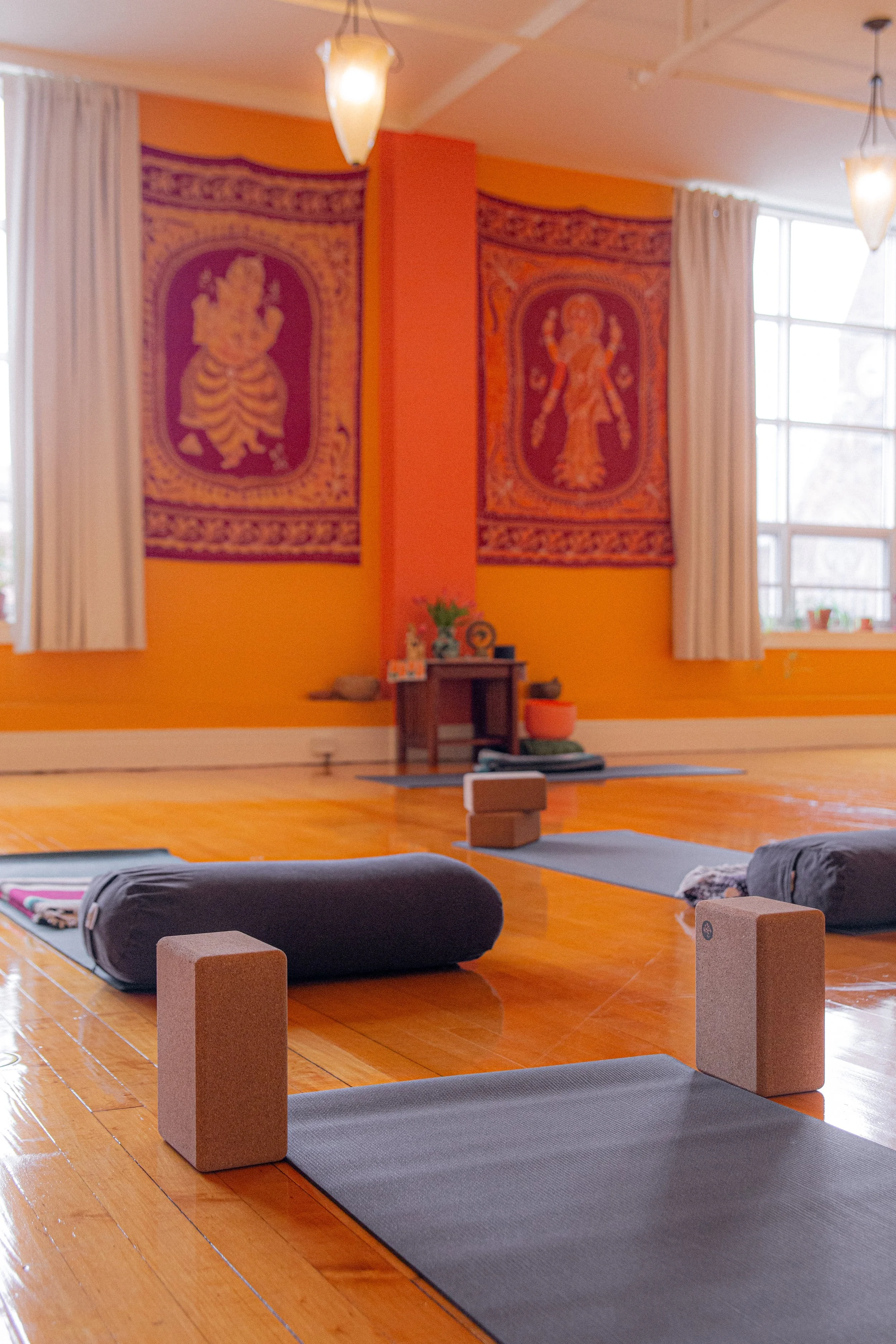
Mindful Flow has long held an important place on Sanctuary’s weekly class schedule. In many ways, it serves as a good representation for the type of practice many of our students are searching for - a seamless blend of mindfulness and embodiment.
This moderately-paced flow is welcoming for students of all levels. We typically start with a centering, and slow warm-up. Class usually includes some sun salutations, standing poses and a slow stretchy wind-down. Students are encouraged to go at their own pace, working with the body they have. Advanced options are offered for those who wish, and rest is encouraged for all when needed.
In a previous featured class segment, Chandra shared that “bringing mindfulness to anything we do makes it more satisfying and interesting. When we bring mindfulness to an exploration of our bodies there is so much learning that can take place. We can, of course, learn from those teachers and people who have spent time in their bodies, but remember that that is a starting place. The real work is about getting in our bodies and feeling around to see what is true for us, as unique, ever-changing individuals. Ultimately, we can each be the experts of our own personal yoga that we cultivate through experimenting, paying attention and learning through what we notice.”
Mindful Flow isn’t derived from one specific lineage of asana, but rather an integration of many styles, as well as mindfulness practices. It’s simply one interpretation of how we can deepen compassion for ourselves, just as we are in that moment. The teachers at Sanctuary bring their own experiences and intuition to guide students toward these endeavors as best they can.
We recently asked some of our teacher’s the question, What is Mindful Flow? Here’s what they shared…
Chandra Cantor (Saturday’s, 9:15–10:30am)
I use my asana practice as a moving meditation. Moment by moment, noticing as much as I can… What is happening NOW. It’s a practice in bridging meditation and action.
Using all my skills, tools, previous learning, intuition and sensitivity, I meet the moment with optimal effort, going towards everything I know to go towards, engaging what is useful and letting go of what is not needed. Then, because I’m always limited by what I actually know and am able to do, I will eventually meet my edge, right where it is. We have edges of flexibility, ability, edges of strength, endurance, understanding, capacity, etc. Even when we are doing our best, it will be as it is.
I might like it or not, but it will be like it is regardless. My job is then to surrender and let life Be. This is definitely easier in some situations than others, but that is why we practice. Not to improve ourselves or change anything, but to release the resistance to meeting life on life's terms. Sure, a side benefit might be increased flexibility, strength, balance or any number of positive shifts. But those results are often slow, subtle and in no way guaranteed. If I move towards what is tight, there is a good chance it will become less tight, but regardless of any change, I might also release my resistance to the tightness which would result in a similar feeling of freedom. Sure it feels awesome to get what you want, but there can be another way to freedom…letting go of wanting.
My mindful flow is like a mini life practice.
Can I start by finding my center?
Can I keep it as I move through some kind of “doing”?
Can I notice when I lose it?
How quickly can I return?
If we can do this in the low-stakes environment of the yoga practice, maybe we can bring this art of surrender in action into more challenging situations in the rest of our lives.
Kayla Ferguson (Thursday’s, 9:15–10:30am)
Patanjail wrote in the yoga sutras, “yogash chitta vritti nirodhah,” translated as “yoga is the cessation of the fluctuations of the mind.” In the next sutra, he wrote “tada drashtuh svarupe vasthanam,” tranlated as “Then the seer becomes established in its essential nature.” So: yoga is the practice of stilling the mind, in order for the seer (me, you) to recognize their essential nature.
I have a very busy mind. I practice yoga because I want to get a glimpse of Truth, Absolute, God, whatever you want to call it, and I can’t do that when I’m busy thinking. Yoga is not just about practicing fancy poses (although that is fun). It is about giving the mind another task, be it listening to the breath, the body, or even the mind, to slow ourselves down. It is part of human nature to have a busy mind, but our thoughts are not Truth. To me, it is a remarkable thing when the chatter quiets even for an instant. Underneath the “doing,” I find a quality of rest. This is what keeps me coming back to my mat.
Luke “Tt” King (Tuesday’s, 9:15–10:30am)
To me, a mindful flow is really the heart of vinyasa practice. Students engage various limbs of yoga through breath, postural practice, and intentional attention, creating that "moving meditation" people describe with asana. The mindfulness really invites us to meet ourselves and know present reality, regardless of what we find there. To audaciously return to the present moment over and over is such a radical act in a world constantly vying for our attention, making this practice a devotion so many of us can benefit from today.